Affichage des articles dont le libellé est alignment. Afficher tous les articles

jeudi 1 août 2013

Alignment Languages

Today I am dealing with a particularly controversial subject: the alignment languages​​! Wayne Rossi of Semper Initiativus Unum spoke about it a month ago here (but I just read his post yesterday beacause I am especially in arrears in reading blogs I usually follow). This post is very interesting, I advise everyone to take a look at it. However, the author evade the main question about alignment languages​​, ie their credibility in a fantasy world. It is on this point that I'm going to focus.

To start, here is the authors' paragraph about them :  
Law, Chaos and Neutrality also have common languages spoken by each respectively. One can attempt to communicate through the common tongue, language particular to a creature class, or one of the divisional languages (law, etc.). While not understanding the language, creatures who speak a divisional tongue will recognize a hostile one and attack. 
-Dave Arneson & Gary Gygax, LBBs.
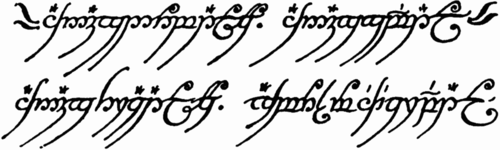
To establish the credibility of alignment languages ​​it is necessary to find precedents or analogous situations in real life and works that inspired D&D. The most frequently cited literary example is Tolkien's Black Speech. But be aware that this creation of Sauron is not spoken by all creatures of Mordor: only a few elites speak it perfectly, while a mob of orcs stammer a patois crossed with Black Speech. Yet it is a good example of a language alignment: only evil creatures speak it more or less (with the exception of some divine creatures, like Gandalf), and it produces an effect of disgust and repulsion on all other races (because of their different alignment).

In reality, what is the closest thing to a language alignment is a religious language (which in itself is not so surprising that alignment in Tolkien or Morcook are closely linked to gods - Valars - or divine creatures - Sauron, Lords of Chaos/Law -). To get closer to the conflict between alignments as presented in OD&D or Chainmail, let's take the example of the Crusades. In those times and those places, speaking Latin in front of a Saracen amounted to a death sentence. The Latin being a dead language used only for the Catholic religion, it is closer to me as to what an alignment language should be : the basic peasant knowing only a few words in Latin (Amen, in nomine Patris, Filii and and Sancti Spiritus) but sufficient (with a few other indications, such as the sign of the cross) to be recognized as Roman Catholic, while priests and scholars being able to have religious debates in that language.

So, based on these two examples (Latin and Black Speech), this is how I play alignment languages: except priests and scholars (and possibly some races or monsters with superior intelligence) of the specified alignment, creatures know only a few phrases, words, and liturgical formulas in their alignment language, which is sufficient for be recognized as being of this alignment, but not enough in most cases to discuss (which adds a language barrier to deal with the monsters of the same alignment).

Does this sounds good for you ?

mercredi 8 mai 2013

Supplement II : Blackmoor - Assassins

Dernière étape avant que je m'attaque à Temple of the Frog : l'assassin !
JB m'ayant précédé sur le sujet, je vais me contenter d'étendre son analyse en ajoutant quelques points que je trouve importants.

Les assassins, dans Blackmoor, font obligatoirement partie de LA guilde des Assassins. Immédiatement, ce point nous évoque quelques références historiques ou littéraires : les Nizârites (des hérétiques chiites ismaélites qui ont sévi entre le 11e et 13e siècle au Moyen-Orient sous la houlette du Vieux de la Montagne), les Sicaires juifs (la branche extrémiste des Zélotes qui combattait l'occupation romaine en assassinant dignitaires romains et collaborateurs juifs de 50 à 70, avant de conduire la première guerre judéo-romaine) et la Confrérie des Tueurs - Slayers' Brotherhood - (une branche de la Guilde des Voleurs de Lankhmar créée par Fritz Leiber). Ces trois références évoquent incontestablement le Moyen-Orient (respectivement la Syrie-Perse, la Judée, et un monde sword and sorcery oriental).

La Neutralité imposée est aussi un indice révélateur, quoique déroutant. Si on se place dans le contexte d'OD&D avec son alignement comme une "position" (voir mon post en anglais sur le sujet), cela tombe sous le sens, étant donné que l'assassin était à l'origine, dans les LBBs, un spécialiste PNJ engagé pour une mission (une variante de l'espion), donc totalement à l'écart des luttes de pouvoir (puisque recruté uniquement avec de l'argent) et ne répondant qu'au maître de la Guilde. Mais si on considère le fait qu'historiquement les sectes d'assassins avaient toutes une facette religieuse, cette neutralité est assez surprenante sachant que les Clercs de haut niveau dans OD&D doivent choisir soit la Loi, soit le Chaos. Peut-être un type de religion païenne (mais les Druides de Greyhawk sont Chaotiques !). Plutôt une philosophie religieuse, alors, d'où la Neutralité. 

Idées à en tirer :
  • Il existe dans le monde de Blackmoor une guilde d'Assassins, spécialisés dans le déguisement et les langues, commandée par un mystérieux grand-maître auquel on peut faire appel pour organiser des assassinats politiques (ou seulement des menaces). Ces meurtres sont le plus souvent commis dans la foule avec des longs poignards ou des sicas enduits de poison. Les Assassins ont interdiction de tuer d'autres personnes que leur cible. 
  • Cette secte mystique est installée dans les bastions montagneux d'une région en Orient, où sa philosophie étrange lui attire les foudres des royaumes et sultanats païens adjacents, qui sont néanmoins terrifiés par les capacités presque surnaturelles des Assassins. Fanatiques, les disciples du Grand Maître tenteront d'accomplir leur mission jusqu'à la mort ou la réussite, et ne commettront jamais de suicide.  
  • Le Grand Maître peut-être défié en combat singulier ou assassiné par un des Assassins qui prendra alors sa place. 
Hmm ! Tout ça a vraiment un goût exotique de Sword and Sorcery ! 


mardi 7 mai 2013

Clerics & Anti-clerics - Part 4

If I had to involve Clerics in my campaign (nonexistent for a while, but who knows ?), here is a description I would make for my players (a summary of what I said previously) :

Clerics are religious warriors who are part of a very hierarchical order worshiping one only God. Once they proved their worth against Chaos, they are finally allowed to follow the Lamas' (or specialist in the Book) teachings. These scholars guide clerics through the five levels of the Book, each one bringing them broader spiritual knowledge manifesting itself by supernatural powers that reflect the cleric's deeper understanding of Creation.

But this exegesis is not unique: other interpretations, sometimes based on apocryphal texts, exist. Some say the world is the result of an unfortunate blend of darkness and light that will eventually split again. Others go even further by suggesting that the Creator is imperfect, as its creation, and that God has nothing to do with neither one nor the other. Lawful clerics are part of the mainstream whereas Chaotic are heretics, often rejected and fought by the Church. Patriachs, who inhabit strongholds, are the regional leaders of the Church wheras Heresiarchs are their counterparts.

Finally, Anti-clerics, who swapped their healing magic against a necromantic magic, gather together in sects worshiping (or even conjuring) demon lords. These cults, based in fortresses, are led by Evil High Priests who seek to overthrow the Church and impose their religion. 


Rules modifications :

Clerics 
-Chaotic clerics can repel the undead.
-Clerics use spell books as magic-users.
-Limited to 5th-level spells.

Anti-clerics 
They are treated as Clerics except for the following: 
-Anti-clerics use Thief Advancement Table for experience only. 
-Charisma is their Prime Attribute. 
-Anti-clerics cast reversed versions of reversible spells.  
-Turn undead ability is replaced by the Demon Control ability. 
Demon Control : Anti-clerics can conjure and/or control a demon whose true name they discovered in their treaties of demonology. Anti-clerics roll on the Turning Undead Table to determine the success of their attempt. If the roll is successful, the demon is under control (as the effect of a charm) for 2d6 days x anti-cleric level. The dice roll must be kept secret. Once this time has elapsed, the demon is free to do what it wants (like disembowelling the anti-cleric) for a number of rounds equal to its type. After that, it returns to where it came from. If the roll is unsuccesful, the demon is free to do what it wants (like disembowelling the anti-cleric) for a number of rounds equal to its type. After that, it returns to where it came from.

lundi 6 mai 2013

Clerics & Anti-Clerics - Part 3

As you may have noticed, there is no accurate description of the Anti-cleric in OD&D. Or rather, a description in the negative: (s)he does not launch the classic versions of reversible clerics spells, (s)he does not repel the undead etc.

This is even better for you! You have full latitude to develop your own Anti-cleric class... Let the creative juices flow! 

Nevertheless, this is a possible vision of the Anti-cleric for OD&D that I designed so that it can be perfectly integrated to the original rules, just between clerics and dwarves in Men & Magic. 

Anti-clerics :  

Anti-clerics are evil alter-ego of clerics of the Law. They are always Chaotic. Organized in hierarchical cults, they worship various demons and can use all the weapons. When Anti-clerics reached the top level (High Evil Priest), they may opt to build their own stronghold, and when doing so receive help from "above". Thus, if they spend 100,000 Gold Pieces in castle construction, they may build a fortress of double that cost. Finally, "faithful" men will come to such a castle, being fanatically loyal, and they will serve at no cost. They will be 30-300 Brigands. Anti-clerics with castles of their own will have control of a territory similar to the "Barony" of fighters, and they will receive "tithes" equal to 20 Gold Pieces/Inhabitant/year. 

Charisma is the prime requisite for Anti-clerics. They can use strength on a 3 for 1 basis (and wisdom on a 2 for 1 basis) in their prime requisite area, for purposes of gaining experience only.  

Anti-clerics
0         Evil Acolyte
1250   Evil Adept
2500   Shaman
5000   Evil Priest
10000 Evil Curate
20000 Evil Bishop
40000 Evil Lama
80000 Evil High Priest 

Anti-clerics fight and save as Clerics. Anti-clerics use spell books as Clerics and Magic-users.  They use the Clerics spell list but Clerical spells underlined on the table for Cleric Spells have a reverse effect, all others functioning as noted. The chief exception is the Raise Dead spell which becomes:
The Finger of Death:
Instead of raising the dead, this spell creates a "death ray" which will kill any creature unless a saving throw is made (where applicable). Range: 12". 

Demon summonning [for optional use as part of Supplement III]: Anti-clerics can conjure and/or control a demon whose true name they discovered in their treaties of demonology. Anti-clerics roll 2d6 on the following table to determine the success of their attempt (possible negative modifiers, positive modifiers depending on special magic items):

Demon  | Shaman | Evil Priest | Evil Curate | Evil Bishop | Evil Lama | Evil High Priest
Type I 11 9 7 5 3 1
Type II - 11 9 7 5 3
Type III - - 11 9 7 5
Type VI - - - 11 9 7
Type V - - - - 11 9
Type VI - - - - - 11

If the roll is successful, the demon is under control (as the effect of a charm) for 2d6 days x anti-cleric level. The dice roll must be kept secret. Once this time has elapsed, the demon is free to do what it wants (like disembowelling the anti-cleric) for a number of rounds equal to its type. After that, it returns to where it came from. If the roll is unsuccesful, the demon is free to do what it wants (like disembowelling the anti-cleric) for a number of rounds equal to its type. After that, it returns to where it came from. Artifacts may allow the summoning of demon princes.
 

samedi 4 mai 2013

Clerics & Anti-clerics - Part 2

So, as I have said in my previous post, here is the summary of what OD&D suggests (more or less explicitly) on clerics and anti-clerics. 

Clerics : 
Clerics are part of a esoteric and military (1C) religious order (perhaps proselyte (6B)) characterized by its study of religious texts (2) enabling them to understand better the creation and get spiritually closer to their unique god. This exegesis of sacred texts gives them powers inaccessible to the profane (5). It's an hermetic society in which clerics progress through successive stages from acolyte unable to use the divine power (because she has to prove her worth) to the patriarch who guide the religious order and leads the Crusades, via the Lama doctor of the Law and the Bishop sent to the Wilderness to conquer his domain by the strength of his arm and the purity of his faith (2).

But as in any religion, strife await because of different interpretations of the Book : Any cleric who rises in the hierarchy of knowledge must eventually choose sides (1A) between the mainstream (the Law) which gathers most patriarchs and the deviant interpretations described as heretical (the Chaos). These are parallel orders* of Chaotic clerics (6A) more or less rejected by the Church of the Law, each led by a different (Chaotic) patriarch named heresiarch (7) which gathers also holy warriors (1C) and fight the undead too (4). Rather than building a fortress, they lead a nomadic life in as missionaries (7).


*for example : blog In Places Deep.


Anti-clerics :
Anti-clerics are always Chaotic and evil (3). They are satanists* who worship many demons that are the source of their powers, counterfeiting the hierarchy of the Church of the Law (3). Evil High Priests also build strongholds for their respective cults (1) and are particularly civil with travelers who stop in their castle and pay their required tithes (6A).

*porphyre77 rightly pointed out that the pagan role was filled by Druids.

Any comment, guys?

vendredi 3 mai 2013

Clerics & Anti-clerics - Part 1

Image of World of Xoth, Thulsa's blog.
Since that I am directed to add the anti-clerics to E&S, I read entirely including three brown books and some messages from bloggers to give me a general idea of ​​how others treat it. And I am very dissatisfied.
Truce of additional considerations ! We
should rather see my interpretation of OD&D. 


(1) "Clerics: [...] When Clerics reach the top level (Patriarch) they may opt to build their own stronghold, and when doing so receive help from "above". Thus, if they spend 100,000 Gold Pieces in castle construction, they may build a fortress of double that cost. Finally, "faithful" men will come to such a castle, being fanatically loyal, and they will serve at no cost. There will be from 10-60 heavy cavalry, 10-60 horsed crossbowmen ("Turcopole"-type), and 30-180 heavy foot. Note that Clerics of 7th level and greater are either "Law" or "Chaos", and there is a sharp distinction between them. If a Patriarch receiving the above benefits changes sides, all the benefits will immediately be removed! Clerics with castles of their own will have control of a territory similar to the "Barony" of fighters, and they will receive "tithes" equal to 20 Gold Pieces/Inhabitant/year."
(2) Clerics:
1. Acolyte
2. Adept
3. Village Priest
4. Vicar

5. Curate
6. Bishop
7. Lama
8. Patriarch
(3) Anti-Clerics: 
1. Evil Acolyte, 
2. Evil Adept, 
3. Shaman, 
4. Evil Priest, 
5. Evil Curate, 
6. Evil Bishop, 
7. Evil Lama, 
8. Evil High Priest.
 -Men & Magic. 


(4)"A full explanation of each spell follows. Note that under lined Clerical spells are reversed by evil Clerics. Also, note the Clerics versus Undead Monsters table, indicating the strong effect of the various clerical levels upon the undead; however, evil Clerics do not have this effect, the entire effect being lost. Note: There are Anti-Clerics (listed below) who have similar powers to Clerics. Those Clerical spells underlined on the table for Cleric Spells have a reverse effect, all others functioning as noted. The chief exception is the Raise Dead spell which becomes:
The Finger of Death: Instead of raising the dead, this spell creates a "death ray" which will kill any creature unless a saving throw is made (where applicable). Range: 12". (A Cleric-type may use this spell in a life-or-death situation, but misuse will immediately turn him into an Anti-Cleric.)"
(5)"Characters who employ spells are assumed to acquire books containing the
spells they can use, one book for each level."
-Men & Magic

(6) "Clerics will require passersby to give a tithe (10%) of all their money and jewels. If there is no payment possible the Cleric will send the adventurers on some form of Lawful or Chaotic task, under Quest. Generally Evil High Priests will simple attempt to slay Lawful or Neutral passersby who fail to pay their tithes."
(7) "Patriarchs are always Lawful, and Evil High Priests are always Chaotic. All other castle inhabitants will be either hostile to the adventurers (die 1-3) or neutral (die 4-6). "
-Underworld and Wilderness adventures
Let's briefly push the open doors : the cleric is a kind of Templar of a pseudo-Christian religion (orthodoxy is the most probable) progressing to status of patriarch (there may be several patriarchs, which can be a territorial division) and attracting at that time a bunch of fanatics in his castle. 

(1A) Neutral clerics must choose their side at level 7 : Law or Chaos. More on this later but keep in mind that alignment is a stance. 
(1B) Clerics receive "help from above"...  does it refers to his superiors or his divinity? Well, we don't know. But I would tend to promote the divinity as Patriarch is the highest grade that can be achieved. And it also allows you to add a little flavor (i.e. the fortress was built where the Patriarch had his mystical ecstasy. His Lord guided him to a chest full of gold buried between the large roots of a tamarind etc.).
(1C) "Turcopole-type" riders ?! This is a precision that has always intrigued me. Turcopoles were Eastern Christians mercenaries who fought for the military orders and the Byzantine army. This fits well with the OD&D cleric-templar, but I have two points : First they are Eastern. Well managed, they can bring an exotic touch to the setting with perhaps different interpretations of the sacred texts or other religious customs, which can sometimes lead to misunderstandings between them and the clergy. Second, one can notice that they are also gathered by Chaotic clerics. More on that later.

(2) Two obvious irregularities : Bishops who do not have castle/cathedral and Lamas. porphyre77 provided an excellent explanation for the first irregularity with bishops in partibus infidelium who wander in the Wilderness to establish or re-conquer their episcopate. For the second irregularity, snorri has rightly pointed out that Lamas are sort of the doctors of the Law (Darhma). More on this later. 

(3) Anti-clerics are Chaotic and evil. Note that they do not have an "evil village priest" nor "evil vicars". These guys are not found in the country and never make sermons in the village church. "Shaman" is an interesting title because it refers to paganism. Talisman calls Anti-Clerics heretics and heresiarchs and this is a nice point of view.

(4) No vade retro for evil clerics (which obviously refers to anti-clerics). Please note that the anti-clerics do not control the undead with the inverted vade-retro of the subsequent editions. By the way, I remind you that anti-clerics and clerics have only 13 spells in common (for information, the magic-users and clerics have 10 in common). The anti-cleric is truly a class apart from the cleric !

(5) Clerics HAVE spell books, as everyone seems to forget (the OD&D retro clone Delving Deeper and E&S are the only ones that I know which includes this rule). Clerics studying books of spells remind me strongly of Kabbalists and the like (hermeticism, gnosticism, mandaeism and manichaeism).

(6A) This paragraph seems oddly enough to distinguish between the Clerics (chaotic or lawful) that cast quests if not paid and Anti-Clerics who kills you if you do not pay them. This may be a drafting error or an unfortunate distinction, but remenber, any deviant interpretation is up for grabs.  
(6B) Another interesting point is that it seems that the Clerics or Anti-Clerics, if they are paid, are the most friendly castellans (even the Evil High Priests !) compared to the Lords and magicians.

(7) This passage invalidates a previous remark unless... there is not only patriarchs and evil high priests (which is indirectly refuted by the random table, but we can try to see where it takes us). More on this later.

The remarks are completed, part 2 will be a synthesis of this mess to see how it can be used in game. You may be a little surprised by my own interpretaion. 

mercredi 1 mai 2013

Lawful Mind-flayers ?

Mind-flayers are truly a fascinating monster. Their diet of brains, their psionic powers, their cthulhoïd look... And their background (they practice slavery, particularly on githzerai and githyanki ; and
they are at war with the Dark elves). 

They are now firmly embedded in the D&D players' mind as the "bad guys". What if... it was a completely false assumption ? What Gygax had in mind when he created illithids ? 
"Law :
Mind flayer [...] highly evil but otherwise lawful."
-Gary Gygax in OD&D, Supplement III : Eldritch Wizardry. 
It could hardly be more confusing... 

I spoke about OD&D alignment in my last post.
It means that mind-flayers fight alongside the Law against Chaos (and possibly the Great Old Ones if they exist in your world. In mine, that's the case).

These creatures created by Gary Gygax appear only in one set of modules which had been writen by EGG : D1-2, Descent into the Dephts of the Earth. In D1, we learn that they are opposed to the dark elves (Chaos), have Were-rat servants (Chaos) and beholder allies (Chaos). Strange dating.

Lately, porphyre77 (a faithful commentator of this blog) rewrote the mind-flayer for Epées & Sorcellerie (we both work with snorri to realease the version 2 of E&S which is the first French retro-clone - I'd probably review it this week) and came with the following interpretation :
"Cette race souterraine à l'allure humanoïde possède une intelligence supra-humaine. Bien que loyaux, ils agissent d'une façon perçue en général comme maligne pour les races plus jeunes qui ignorent tout de leurs objectifs et façon de penser."
-porphyre77 in E&S v2.
"This subterranean humanoid race has superhuman intelligence. Although loyal, they act in a way generally regarded as malignant by younger races who know nothing about their goals and way of thinking."
-porphyre77 in E&S v2 (english translation).
That's brilliant !

Before interpreting the oddity, I must admit it made ​​me think of the Carcosa Space Aliens :
"SPACE ALIENS [Law]: Roughly human in shape and size, though unmistakably alien, these invaders from outer space have hairless, light gray bodies. They tend to be slender, and they have unblinking, bulbous eyes with black irises. Thousands of years ago, an armada of them made a hard landing on the planet of Carcosa. Since then, others of their race have come and gone while establishing bases on the planet—undoubtedly for some nefarious purposes. The Space Aliens possess a highly advanced technology, though they mostly lack such things as art, emotions, religion, philosophy, etc.
[...]
Law is the alignment of those who oppose the Great Old Ones. This opposition need not be (and is usually not) active. If, however, an Old One were to be released from imprisonment, those of lawful alignment would fight against it."
-Geoffrey McKinney, Supplement V : Carcosa (emphasis added).
So basically, we have two solutions (not necessarily exclusive) to handle the situation. Let me develop them to see where they lead :
  • Mindflayers are geniuses without morality who plan ahead the downfall of Chaos. Their devious plans may include providing assistance to their Chaotic enemies or may even include attacking other Lawful races if it can help them to strengthen their position. This disregard of their natural allies can be explained by their excessive pride that drives them to make light of the inferior races little able to fight against the Chaos and meant to be their slaves. This attitude may also be explained by their paternalism towards other races that they educate by reducing them to slavery in order to "civilize" them. 
  • Mindflayers are evil beings who oppose Chaos with a highly advanced science. Why are they fighting Chaos and the Great Old Ones that they resemble physically and mentally (they have great evil in common)? Nobody really knows. Maybe the mindflayers were previously a servant race of the Old Ones... They may have rebelled and now seek revenge. Or maybe they were the ones that the dawn of time, have imprisoned the fouls Old Ones because of a feud? Perhaps they are the immemorial Elder Ones!
Their high technology relies certainly on the minds they consume. Perhaps even navigators of their spaceships are giant brains with surnatural perceptions and terrifying mental powers immersed in vats of amniotic fluid... This is undoubtedly the reason why they enslave the inferior races: they need a lot of brain matter to create such horrors!

mardi 30 avril 2013

OD&D Alignment

A classic subject, undoubtedly... 
What say the three little brown books about it? Very few things, but as always, very interesting. The authors, Gygax and Arneson, simply, as they say, provide guidelines. Cryptic guidelines that the reader must decode to soak up the spirit of the original rules. Well, some quotations now :
"Before the game begins it is not only necessary to select a role, but it is also necessary to determine what stance the character will take - Law, Netrality, or Chaos. [...] One can attempt to communicate through the common tongue, language particular to a creature class, or one of the divisional languages (law, etc.). [...] Monsters can be lured into service if they are of the same basic alignment as the player-character ..."
-Gygax & Arneson, OD&D : Men & Magic (emphasis added).
Two words stand out from the crowd : stance and divisional. A stance is "the attitude of a person or organization towards something; a standpoint" (Oxford Dictionary). So alignment is the attitude of the character/monster towards something (what ?). It's NOT a trait, a way of behaving or something like that. This is closer to a political opinion. 

"Divisional" is also very informative : a division is (inter alia) "one of the parts, sections, or groups into which something is divided", "an administrative and tactical military unit that is smaller than a corps but is self-contained and equipped for prolonged combat activity" or "a splitting into factions; disunion" (Oxford Dictionary). So, alignment (interpreted by the book) is a military division into several factions resulting from "political views" (intrinsic or not). Here we are back to the days of wargaming (Chainmail, Arneson's First Fantasy Campain and its army list depending on alignment) : races supporting militarily one of the fighting factions (men and several other peoples are divided on this). Think of a civil war or better : think of Ragnaroth.

The Threefold Apocalyptic Alignment. Choose your side : the Asgardian gods, the Great Old Ones or the Wildness ! 

Wait... you said Great Old Ones ?  
"Alignment on the planet of Carcosa is defined solely by one’s stance towards the Great Old Ones. Nothing else is considered. All behaviors, including the most noble and altruistic as well as the most vile and despicable, are found amongst all three alignments. Similarity of alignments does not necessarily indicate friendship, and opposite alignments does not necessarily indicate enmity. For example, nothing is unusual in a lawful man and a chaotic man joining forces to defeat a lawful foe."
-Geoffrey MacKinney, Supplement V : Carcosa (emphasis added).
Yes... it's a stance. Choose your side and drop these prohibitions and these forced behaviors.
Choose OD&D !